Posts in Category: Toronto
Losing Focus: Finding Interest in Blurry Photos
***If you are looking at this on your phone you probably won’t see the blur in these photos. Your phone will crush the images to the point where they will probably look in focus. Of all the posts so far, this one needs to be seen on a bigger screen to make sense…
***photographers: this article is not about using diffusion filters to soften focus.
Finding something interesting in “mistakes”
Over the years, I have taken thousands of pictures. Sometimes they turn out great. Often times they don’t. Sometimes the image I was seeing in my mind didn’t translate well with the camera or, other times, the photos are technically flawed. My camera is older and the auto-focus system is not perfect. It struggles with difficult light and reflections, especially at night. So, I tend to get a few photos that are out of focus from time to time. These blurry pictures are impossible to fix and I always delete them first, without any thought, to save space on my computer.
Lately, I have found a few of these pictures that escaped getting deleted. While they are not what I intended, some of them are still kind of interesting. Unfortunately, only a few of these “mistakes” have survived. So, I decided to go out and try to take some out of focus pictures on purpose and see if I could come up with some good shots.
This project turned out to be much more difficult than I thought. My idea was to just go out, find an interesting scene, manually de-focus the camera and shoot away. I shot hundreds of photos and the majority looked terrible…not interesting…just BAD pictures.
But, over a couple of weeks, I managed to figure out which images are more likely to make a good blurred photo. Here are the ones that I think turned out pretty well.
Shooting through moving water


Manually de-focussed still life shots around my apartment
These photos have a dreamy quality about them: you know what they are but all the details are missing. Like…you know there was a person in your dream…you know what you said, you know what you did…but you can’t see their face no matter how hard you try to remember….these pictures have that kind of feeling for me.


Out in the city at night
I thought night shooting might be a little easier but it was just as difficult to get an interesting shot. Here are a few that I did like. In the city at night, there is a lot of hard contrast in the lighting which I found helps to give some structure to de-focussed pictures.


Time Travel

Photos that look like paintings
Scenes with strong texture and clear structure can make good unfocussed images. Because of the large grain and the soft transition between colours, these ones look like oil paintings to me.


Ghosts…
Images with people in them turned out to be some of the most interesting ones. They all look like dream scenes to me. They are clearly people but their limbs are distorted and their faces are obscured. This is how I tend to remember characters from dreams. I don’t think I have ever seen a ghost but, if I did, I imagine that this is what they would look like.


What’s next…?
This was a difficult project and I am kind of glad that I can get back to taking “normal” pictures again. I am really happy with these few good shots that I did come up with. I hope you like them too. Working on a project about shadows…
As always, you are welcome to leave questions or comments below. I am always happy to hear from you. Knowing you have been here motivates me to keep at it. Thanks for looking!
If you enjoy the content and would like to contribute towards website maintenance and development, you can make a donation here.


Midori: Experiments in Green
Please try to look at this post on a laptop instead of your phone. It will look much better.
The World of Wong Kar Wai
I recently found a big picture and essay book about Wong Kar Wai on my bookshelf. I must have bought it years ago and, because I was so busy, never got around to reading it. These days, I have been sitting on the floor every morning and reading it cover to cover as I drink my coffee. The book inspired me to see his films again and I have been watching them one by one in chronological order.
One of the things I love about Wong Kar Wai and his cinematographer Christopher Doyle is the way they use strong colour casts to emphasize mood or setting or time. Often it is a prominent green, especially noticeable in Days of Being Wild, Fallen Angels and even In the Mood For Love. The photography in these films is so striking that on the first viewing, I end up misunderstanding the story because I am so focussed on the images alone. I have always loved these green steeped scenes the most.
Here is a famous example from the end of Fallen Angels:

My Fujifilm X100T
This 10 year old camera is the only digital camera I have ever owned. By today’s standards, it is pretty old technology but I still love it. I have always been able to capture any picture in my imagination with this little machine. If you are interested, I describe it in a more detail at this link.
A few days ago, I decided to try to take some green toned pictures. I wanted to see if I could make some images that come close to the ones I love in the Wong Kar Wai films. I did this by manipulating the white balance of the camera and pushing it hard to the green side. How to do this is not really that interesting so I won’t go into it here but, if you want to know more about it, there are lots of good articles on the subject. Usually, you manipulate the white balance to keep your colours more natural under different kinds of light (like sunlight vs LED lightbulbs indoors). I did the opposite, manipulating white balance to get unnatural colour tones.
Here are a few of the pictures I like the best
I just took pictures of regular things..no extra effort to make cinematic compositions this time…


On my way home to write this post today, I was thinking..
Ever since I was little, if you asked me what my favourite colour is, I would say “green”. Always. The green of the sea, the green of the forest, the green of kelp and algae, the green of moss. Always green.
As I was walking home and thinking about writing this, I was listening to Luminescent Creatures, Ichiko Aoba’s new record. I only know a few words in Japanese but, every now and then, a word will pop out and stay with me… most often just because I like the sound. On the last track, which is so beautiful that I listened to it twice today, the word was “midori” 緑. When I got home and looked it up, it turns out to be the Japanese for word for “green”.
When I rolled that word around in my mind a little further, I realized that I had heard it before. In the movie Norwegian Wood (adapted from Haruki Murakami’s novel of the same name), lead character Toru Watanabe’s true love interest is named Midori. This film, directed by Tran Anh Hung, is full of vibrant green…just like his other famous film, The Scent of Green Papaya. And the cinematographer for Norwegian Wood was Mark Lee Ping-Bing who also worked on Wong Kar Wai’s In the Mood for Love. So many connections…

Green, my favourite colour. Green, the colour of summer. Midori…something beautiful. Green has been in my heart for the last few weeks. Maybe because it is mid summer after a rainy spring and the whole city is flooded with shades of green. Hope you enjoyed the pictures. I really like them. I will keep working on it.
If you have any comments or questions, please leave them below. I am always happy to hear from you : )
If you enjoy the content and would like to contribute towards website maintenance and development, you can make a donation here.
Tommy Thompson Park in Early Spring
An accidental nature refuge
Tommy Thompson Park is a 5km long spit of land that stretches into Lake Ontario at the south east end of Toronto. It is entirely manmade, consisting of silt dredged up from the harbour as well as construction and demolition material produced over the last 75 years as the city grew. The shores of the park are made up of mostly broken concrete, tile and brick which have been eroded by wind and water over time. Shanks of twisted iron rebar jut out from the shoreline like rusty branches. Although it doesn’t sound so picturesque, it is actually quite beautiful.
Nature has taken over as this pile of dirt and rubble has sat here mostly undisturbed. It is now home to indigenous plants, animals, birds and insects. Some rare migratory birds make Tommy Thompson Park an annual nesting ground and there are areas of the park that are closed off during most of the year to allow them to nest in peace. Cars are not allowed. Even dogs are not allowed as the permanent residents of the park see them as predators.
Because it is remote from the city and protected by environmental laws, it is a great place for spotting beavers, minks, martens, coyotes, geese, swans, all types of ducks, birds of prey, insects, turtles, snakes, frogs…. Even Snowy Owls and Bald Eagles make stops here.
Since there are no cars it is also an ideal place for a walk or bike ride when you feel like escaping from the noise and hustle of downtown. For more detailed info here is the official website.
Photos and sounds from an early spring visit to Tommy Thompson Park


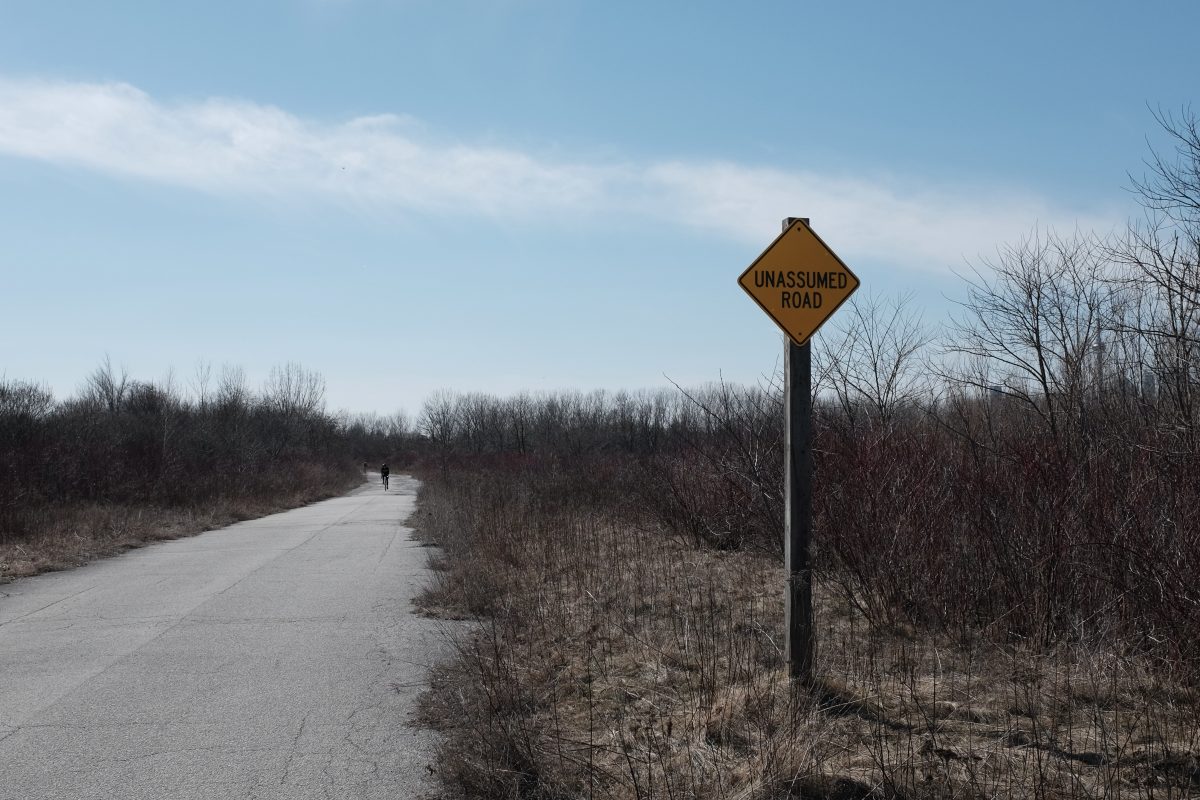


I expected it to be noisier, but except for birds quietly nesting and people cycling and chattering away, it was almost silent. Below is a sound sample from late summer. In contrast, the sounds of cicadas, crickets and bees is LOUD! You can also hear a Porter Airlines or Air Canada Dash-8 flying over. This is a typical sound of the park which is at the end of one of the Toronto Island Billy Bishop Airport runways.
This park changes dramatically with the seasons…let’s come back later and see what’s going on.
If you enjoy the content and would like to contribute towards website maintenance and development, you can make a donation here.