Spirit Wares: marketing solution
The Problem
I was contacted by one of the partners Spirit Wares to help them solve a problem marketing a new line of plates. The collection is beautiful, with unique unfinished sandy edges and thick bright white glaze.
Spirit Wares plate collections immediately evoke images of nature: blue water, silvery ice, mottled quail egg. The colours and textures are bold and recognizable. This is part of their brand identity. It sets Spirit Wares apart from other plate manufacturers, giving modern chefs inspiration with an original and natural canvas to work from.
But these particular plates are….WHITE… Although they are beautiful, their identity and how they fit into the Spirit Wares collection is not so easy to divine. The original name “Glazed White Marble” was not making an impression and sales were weak.
I was tasked with coming up with a new identity for the collection.
Here are a few examples of the plates:


The Solution
When I got a chance to see them in person, their appeal was immediate. I saw something in them; I recognized them, especially on the edges where sandy raw stone meets the bright white glaze. This image is a perfect example:

Marketing these plates successfully required making a connection between their design and nature.
Over the last few years I had been thinking about traveling to Hokkaido in winter. I wanted to experience one of the snowiest places on earth. I remembered seeing a few images of Japanese coastlines in winter that reminded me of the plate edges that I was looking at now. Here are a couple of the images below:


I thought that naming the collection with an easy association (“snow and sand” for example) was not very interesting. Instead, naming it after a place where this unusual natural phenomenon happens was far more appealing. The idea of naming it the “Hokkaido Collection” came from here.
The name “Hokkaido” sparks curiosity and gives personality to this snowy sandy plate collection that would otherwise get lost among its more colourful and easily recognizable competitors. A bump in sales after the renaming seems to back this up.
You can see all the collections at Spirit Wares
Mission to China
Let’s Go!
Many years ago I was invited by the Oysterlicious Group to work in Shanghai, China.
I had never traveled to Asia before and my first question was: “WHY? Why would I want to leave my home? Why would I want to go half way around the world to a place that I knew nothing about?” I couldn’t even speak the language.
But, after some time, my thoughts changed to: “actually…WHY NOT? Here I am with an offer of a free flight, accommodation and a job in a place that I would probably never think to visit on my own. This is an opportunity, not a problem”.
So began an adventure that would open doors to an exciting future. I packed my bags and set off on a journey that would change my life forever, a journey that has still not come to an end.
The beauty of Shanghai


Before coming to work in China, it seemed like a mysterious place, an unknowable place, maybe an unwelcoming place. But, from the moment I stepped off the plane, I was greeted with kindness and hospitality. I witnessed the beauty of natural landscape blending with space age architecture, ancient culture alongside ultra modern technology. Everywhere I looked there was something new and exciting to experience. Sights, sounds, smells and tastes that were exotic and irresistible. I was hooked on day one.
Work and Play in Shanghai


I was tasked with training a crew of young Chinese cooks. An exclusive oyster bar and restaurant in Shanghai would be my new workplace. At first, I was anxious about teaching them, especially since we didn’t speak the same language. But, my worries were short lived. These men were dedicated and hard working. They were eager to learn anything I was willing to teach them. With the help of our smart phones and sign language, communication became easy. We taught each other food words in Chinese and English and soon language was no longer an issue.
Outside of the kitchen, I was able to share time with the cooks and Oysterlicious hosts, eating and exploring Shanghai. China is a country where social connections are the greatest currency and it is not difficult to make friends over a good meal.


My kitchen mates often took me out to eat and drink at their favourite local places. These were real Anthony Bourdain style food adventures, memories I still hold dear many years later.
As a foreign professional, I was also sought after to promote oyster culture in Chinese media. I was a minor celebrity overnight!
Travel time in China


Being a cook is hard work anywhere in the world and China is no exception. But, it wasn’t all sweating and grinding away. There were also opportunities to relax and travel. The beauty, mystery and cultural richness of China went beyond all my expectations. And the Chinese people I was lucky to meet always treated me with kindness and patience.
This fateful trip was the start of a long and deep relationship with Asian culture. I have traveled back to China may times to see the friends I made on this first journey and I have traveled to Japan and Korea as well. Without the initial offer and encouragement I received from the Oysterlicious Group, I would never have had the opportunity to enrich my life in such a profound way.
Why go to China?? The reasons are endless. Better to ask: “Why not?” And then pack your bags.
Check out the Oysterlicious Instagram for more information.
If you enjoy the content and would like to contribute towards website maintenance and development, you can make a donation here.
Quick and Easy Napa Cabbage Kimchi Recipe
It takes 2 hours to brine cabbage. There is no way around this. So, if you are wondering what quick kimchi is, I would say “2 hour kimchi”. If you salt the cabbage first thing, it will take around an hour to produce the kimchi paste and then an hour of waiting for your cabbage to finish brining before you mix everything together. Relative to all the other ways of making cabbage kimchi, this would be the fastest.
I first started making Napa cabbage kimchi in my professional restaurant kitchen, 12-16 heads of whole cabbage at a time. Determined to do everything by hand, I bought fresh garlic and peeled and minced every clove with a knife (2-3 hours just for this). Carrots, onions, radish, ginger: all cut by hand. My goal was to produce the most “hand-made” perfect kimchi I possibly could. Efficiency was not so important. Between shopping for all the ingredients, hauling them to the restaurant and finishing the kimchi, it took me the better part of 2 whole days. Of course, I had prep cooks to help with all the peeling and a dishwasher to clean up after me.
Did all this hand-work make any difference? I am not sure. At the time, as a non-Korean chef, I thought I had better try my hardest to make it as traditional as possible. But after reading lots of recipes and speaking with Korean cooks and friends that I knew, it seemed that most of their moms or grandmas were using food processors to make the process more efficient. Efficiency: this is a Korean tradition as well! The kimchi I make at home these days is just as delicious and makes less of a mess. Making cut kimchi instead of whole cabbage kimchi also makes the whole process a lot faster and saves me the trouble of cutting fermented kimchi every time I want to use it.
INGREDIENTS:
- 1 whole Napa cabbage (around 2kg)
- 80grams (around 1/2 cup) of Diamond Crystal kosher salt ***if you are using another kosher or sea salt, weigh out 80gr. DO NOT use fine table salt in this recipe.***
- 1 1/2 cups water
- 1/4 cup rice flour
- 1 tablespoon sugar or maesil plum syrup
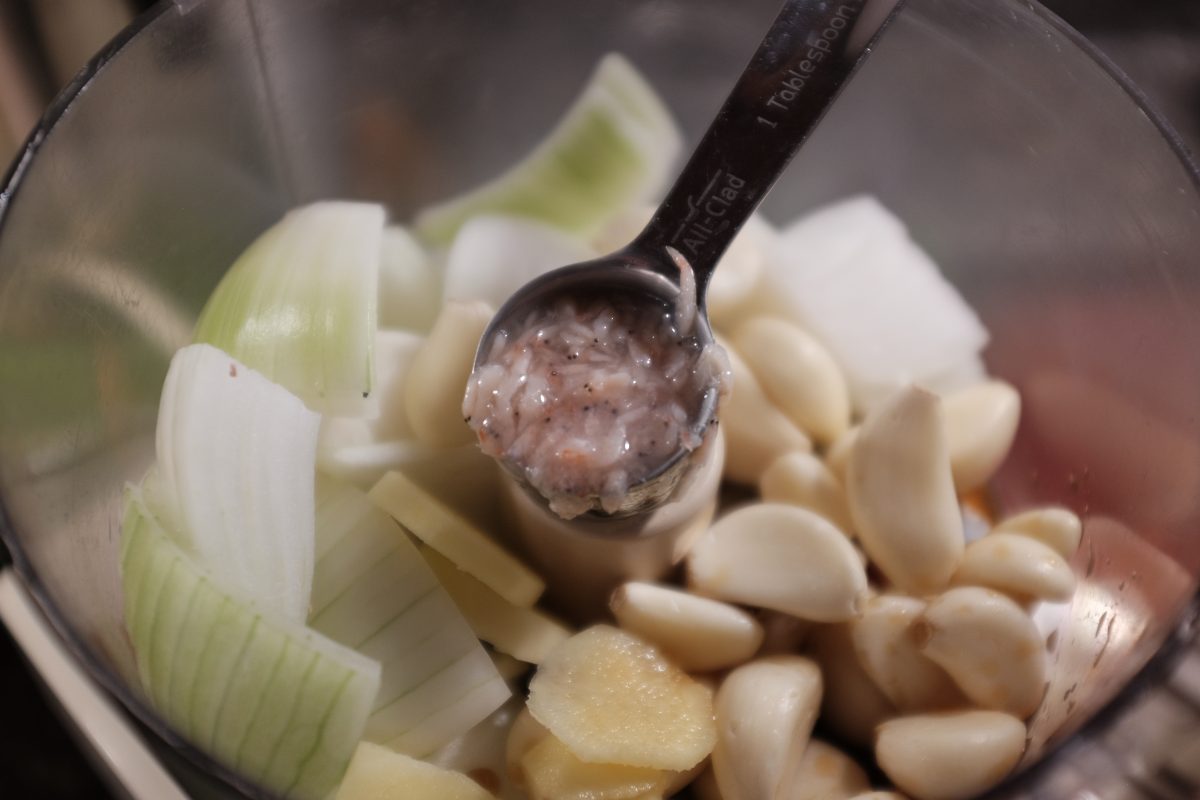
- 1/2 cup peeled garlic cloves
- 1 tablespoon fresh ginger sliced
- 1 medium onion
- 1/2 korean pear peeled (you can substitute a regular pear or apple)
- 1/4 cup fish sauce
- 1 tablespoon salted shrimp
- 1 cup mild korean chilli flakes (gochugaru) ***start with much less if your chilli flakes are very spicy. Taste first and add more as you like once the paste is done.
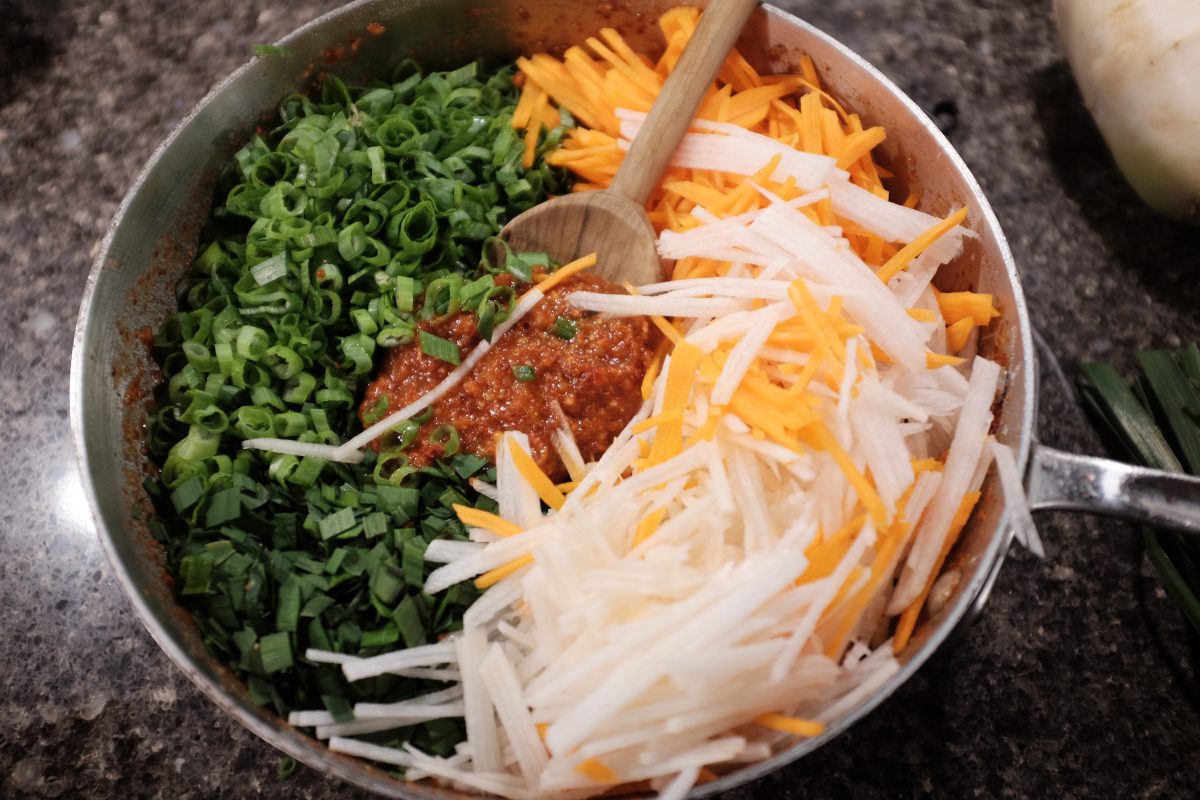
- 6 green onions
- 1 cup carrot cut matchsticks
- 1 cup korean radish matchsticks
- 1 cup chopped buchu (asian chives) or watercress (minari)

PROCESS:






VEGETARIANS/VEGANS
You can find my straightforward recipe for vegan napa cabbage kimchi here.
IF YOU DON”T LIKE SPICY FOOD…
…just leave out the chilli flakes. Your kimchi will still ferment and be delicious.
Enjoy!
That’s it! A very simple kimchi recipe. It is still pretty messy and time consuming but, it will always taste better than anything you will buy in a jar at the grocery store and you will have the satisfaction of handpicking all of the ingredients yourself and making it as spicy as you like. If you have any questions, please leave them in the comments.
Here is a link to my favourite kimchi fried rice and kimchi jjigae with tuna recipe. And for more ideas about what to do with your new batch of kimchi, have a look at this post.
If you enjoy the content and would like to contribute towards website maintenance and development, you can make a donation here.